
武林外传
China, Indonesia pledge deeper strategic synergy, firm support for each other's core interests at strategic dialogue_我的网站

一 |
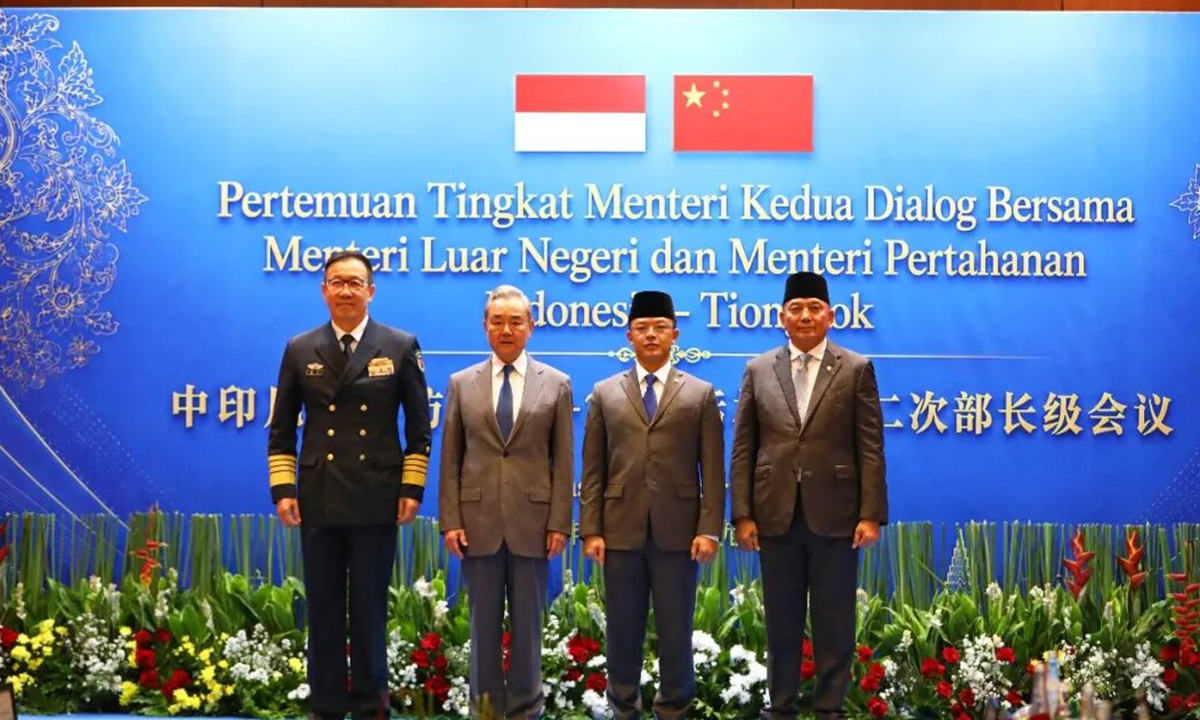
Chinese Foreign Minister Wang Yi and Indonesian Foreign Minister Sugiono co-chaired the conference. The two sides had an in-depth exchange of views on advancing the building of a China-Indonesia community with a shared future and reached broad consensus, according to Chinese Foreign Ministry's readout.
Wang said that the establishment of the comprehensive strategic dialogue mechanism is an important initiative for the two sides to implement the consensus reached by the two heads of state and advance the building of a China-Indonesia community with a shared future that enjoys regional and global influence.
Noting that China has always placed Indonesia in an important position in its diplomacy, particularly in neighborhood diplomacy, the Chinese top diplomat said China stands ready to work with Indonesia to strengthen all-round China-Indonesia cooperation, and pool greater development synergy to jointly tackle risks and challenges.
Stressing that the conference marks an important milestone in bilateral relations, Sugiono said China's development has brought enormous opportunities to the world, particularly neighboring countries such as Indonesia.
Sugiono added that Indonesia firmly adheres to the one-China policy and supports China's cause of reunification. Just in mid-August, the Chinese and Indonesian navies held a joint naval navigation exercise in waters east of China's Taiwan island.
The two sides also agreed to uphold strategic autonomy and firmly support each other's core interests. They also decided to launch the formulation of the China-Indonesia Five-year Action Plan (2027-2031).
The dialogue mechanism was established when Sugiono visited Beijing in April 2025.
Following the Conference of the China-Indonesia Comprehensive Strategic Dialogue Mechanism, the two sides also held a "2+2" meeting, pairing foreign and defense ministers in joint dialogue.
During the meeting between Chinese Defense Minister Dong Jun and his counterpart Sjafrie Sjamsoeddin on Friday, the two sides stated that under the strategic guidance of the heads of state of the two countries, the military-to-military relations face favorable development opportunities with broad prospects for cooperation.
Both sides should continue to strengthen military mutual trust, maintain close exchanges between the two militaries at all levels, deepen practical cooperation in multiple fields, and work together to safeguard regional peace and stability.
"Amid rising power politics, hegemonism, and protectionism, the first China-Indonesia Comprehensive Strategic Dialogue Mechanism conference has further enhanced strategic mutual trust and lifted bilateral relations to a new height," said Xu Liping, director of the Center for Southeast Asian Studies at the Chinese Academy of Social Sciences.
At its core, the mechanism does not target any third party; rather, it upholds win-win cooperation, peaceful development, and multilateralism while promoting collective self-strengthening of the Global South, said Xu. "It sets an example for the region and beyond, effectively offsetting extra-regional interference and noise from within and outside the region."
In specific areas, the two sides pledged to expand cooperation in areas such as artificial intelligence and poverty reduction. They agreed to restart cooperation in fishing, accelerate maritime cooperation and push forward joint development.
Both sides agreed that deepening cooperation in energy and mineral resources serves their common interests, and expressed readiness to jointly build a comprehensive, open and green partnership in energy and mineral resources.
Official data shows that China has been Indonesia's largest trading partner for 13 consecutive years, with bilateral trade reaching $167.49 billion in 2025, up 13.4 percent year-on-year. From the Jakarta-Bandung High-Speed Railway to industrial parks and other projects, the two sides have maintained a sound momentum of cooperation.
"As two important Global South countries with highly complementary economies, China and Indonesia have taken the lead in the region in integrating traditional sector cooperation with emerging economic cooperation," said Xu.
He added that Beijing-Jakarta cooperation is characterized by equal emphasis on and deep integration of traditional and new-quality productive forces. "Firmly grounded, multi-dimensional in scope, and rich in substance, it has become a bellwether for regional cooperation," Xu added.
In terms of the regional and global scope, the two sides also agreed to deepen cooperation within the framework of the four major global initiatives, strengthen policy coordination in multilateral mechanisms such as the United Nations and BRICS, oppose unilateral bullying and power politics, and safeguard international fairness and justice as well as the legitimate rights and interests of developing countries.
The two sides agreed to fully and effectively implement the Declaration on the Conduct of Parties in the South China Sea and work toward the early conclusion of the Code of Conduct (COC) in the South China Sea.
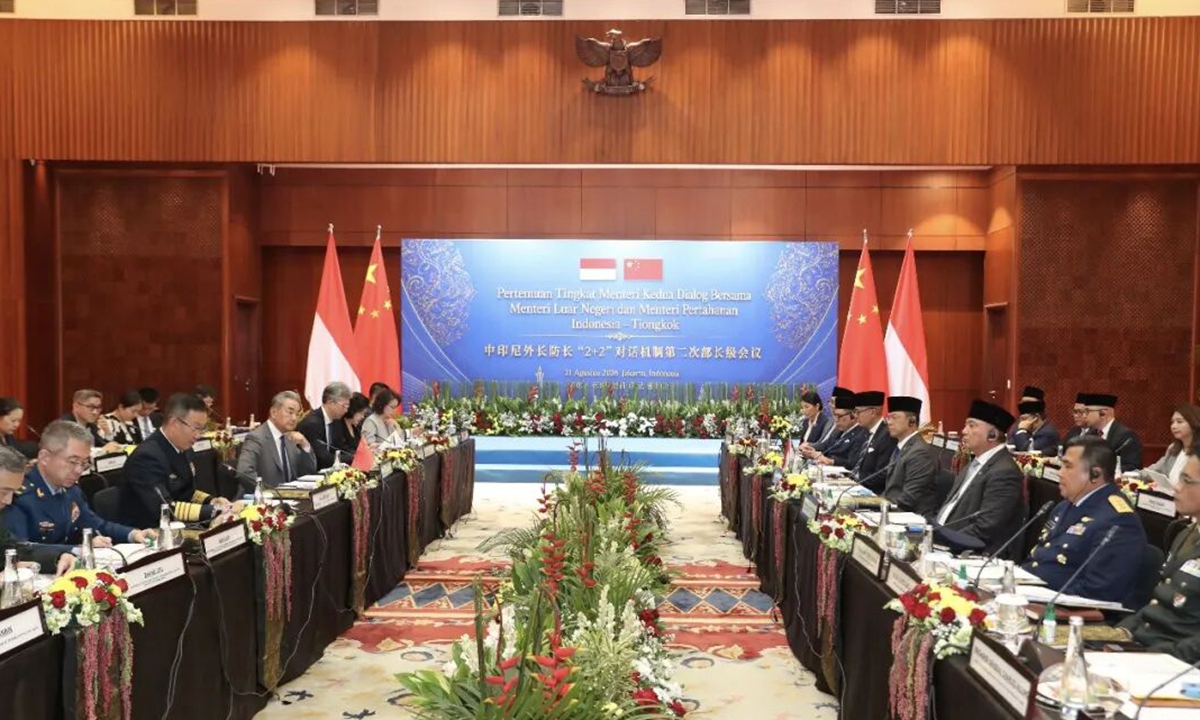
During the "2+2" meeting, the two sides agreed to deepen defense cooperation and promote the regularization and institutionalization of practical cooperation in areas including equipment and technology, joint exercises and training, personnel training, and maritime security, while continuously improving the quality and effectiveness of such cooperation, according to a readout released by the Chinese Foreign Ministry.
The two sides jointly advocate an Asian security model featuring shared security, and will work to uphold the mainstream of regional cooperation and peace and stability in the South China Sea, the readout said.
Amid attempts by certain countries to create trouble and fabricate confrontational false narratives in the South China Sea, China and Indonesia, both important South China Sea littoral states, are duty-bound to jointly safeguard regional peace and stability, said Xu. "Their consensus on this issue injects positive energy into the region, contributing to the early conclusion of the COC."
According to the expert, despite disputes, the overall situation in the South China Sea is manageable and stable, and the close cooperation between China and Indonesia demonstrates to the international community the broad trend and aspiration of peace, friendship, and cooperation in the region.
。

二 | Tarun Mansukhani recently brought the Kapoor family together in Dining with the Kapoors, a Netflix documentary that offers a glimpse into the lives of one of India's biggest film families. The Dostana and Housefull 5 director served as creative producer on the show, which was created by Armaan Jain. In an exclusive conversation with Filmfare, he talks about how the private family welcomed the cameras into their home. He opens up about the emotional visit to Raj Kapoor's Deonar Cottage and reflects on the different worlds of stardom he has experienced, from working with Shah Rukh Khan, the Bachchans and now, the Kapoors. Excerpts: How did you come on board for Dining with the Kapoors? Armaan and I have known each other for a while. He was supposed to assist me when I was trying to make Dostana 2. The film didn't happen, but we kept in touch. About four years ago, he approached me with the idea that he wanted to do something with his family and food. Back then, I didn't know the family as intimately as I do now to realise how important food was to them. We kept brainstorming over random ideas until Armaan said that he wanted to have one lunch with all the family members coming together and the camera shooting them. My first reaction was, 'Good luck with that,' because I knew the family was very private. They don't like cameras coming into their personal spaces. Even Ranbir and Alia had a very intimate wedding. I wondered how Armaan intends to pull it off, but we decided to give it a shot. That's when the process of speaking to all the family members began. I sometimes accidentally call them actors, but eventually, you realise they are just Armaan's family. They all agreed without hesitation. Was it a logistical challenge deciding who would be present for the shoot? I don't think there was any Kapoor family member who didn't want to be a part of it. In a family that has always done this as a ritual, there was no thought of excluding anyone or avoiding certain members. The challenge was about dates. We asked everyone to give us 10 options and mixed and matched until we found one date that worked for all. After we got the family together, it was then about capturing the moments between them. It has come out well. After a point, they let go of the fact that the cameras were recording them. What was your most surprising discovery about the Kapoor family? I had a perception of what the Kapoor family would be like behind closed doors, and it was completely shattered. You often see them as big actors and stars but in reality, they are just a normal family. Reema Jain feels like multiple aunts of mine and Dabbu uncle (Randhir Kapoor) was like my uncles with his sarcastic remarks. How they interact with each other is how we are with our cousins. What shocked me the most was the normalcy within the family. Nobody was a big star at the table. Everything was just about being together and wasn't anything to do with the film industry. How was the mood during the shoot? It was a bit odd at first with the paparazzi waiting for you, making it feel professional. But you look around and realise it's all family. You are meeting, greeting and talking and suddenly you realise there is a camera. So it stops you in that moment from being yourself. But slowly, you start to go back into being who you are. When Ranbir and others went into the kitchen, that wasn't scripted. Armaan was arranging everything on his own and the family just decided to help. Navya and Shaira were plating, somebody else was putting tadka somewhere or buttering naans. Everything was just moving. They are like a big mad unit together. With the changing definition of stardom, how would you define a star now? Everyone is trying to figure it out. Earlier there were clear markers of stardom such as fan frenzy, brand deals or box office hits. Today, with the way the world has changed, our perception of stardom is gone. There is no metric that has popped up for us to reevaluate. Today, everyone is a star and yet no one will ever be Mr. Bachchan, SRK or Salman Khan. I don't think we will ever see that kind of fan frenzy but there will be a redefinition of stardom. Then there will be a lot of other stars. If you could create a Dining with the Kapoors style show again with another film family, who would you pick? With the other Kapoors - Mr Anil Kapoor and his family. We are in talks for a second season and hopefully, will get to announce something soon. Also Read: Exclusive:Tarun Mansukhani on Unbreakable Bond With Karan Johar & Priyanka Chopra’s Desi Girl Legacy。
Current article:http://v4u0mg.nenyaogecebenliexi.shop/pg9i2/20260826/8922774.html
Published on:02:31:50